Pages

Thursday, 15 October 2020

Cone 6 spoons and Val's Turquoise two ways

spoonsbowls 

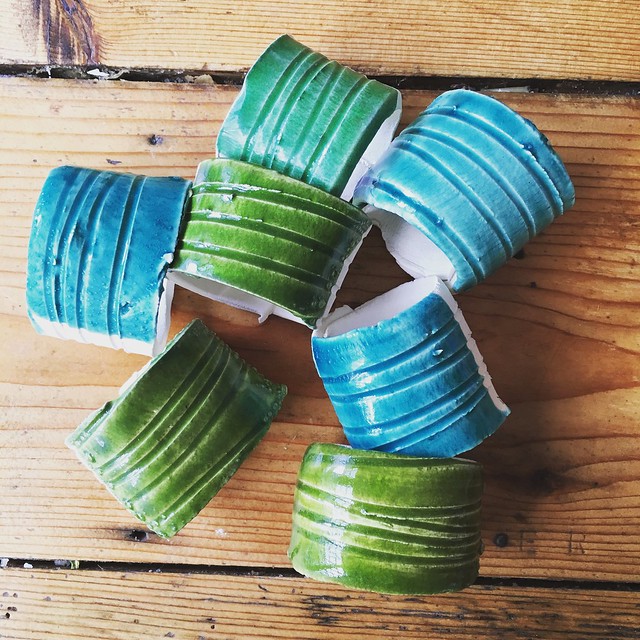
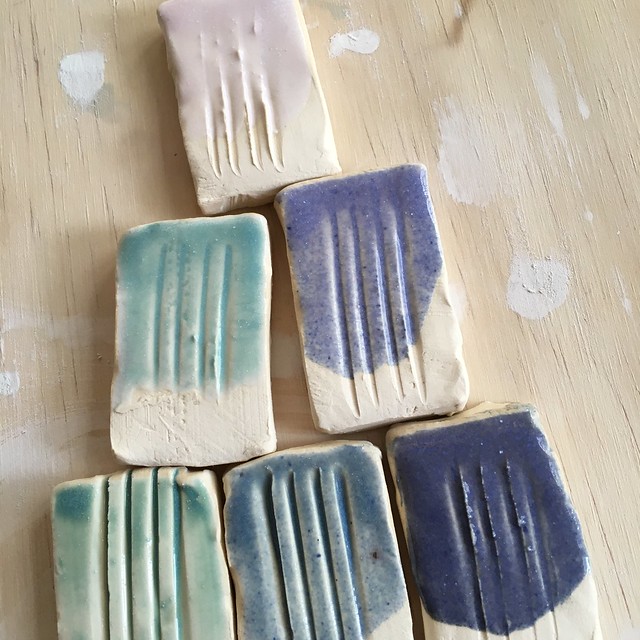
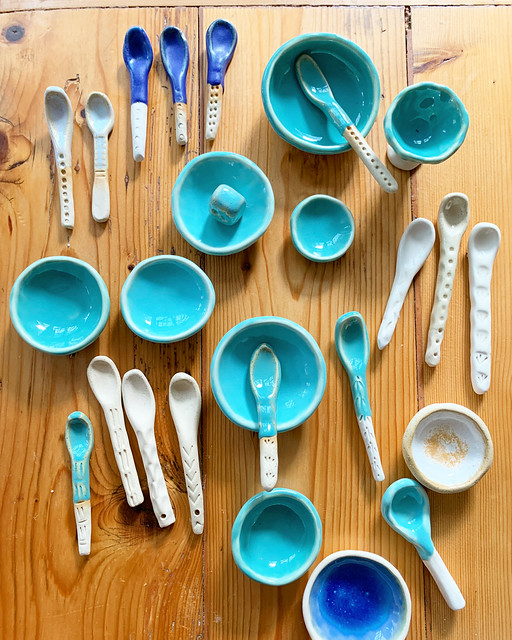
Val's Turquoise two ways - bowls and spoons, clockwise from top left selsor chun, ashley's best, cesco clear.

I haven't done anything for a while, so to get going again with glazes I dipped some of the spoons I've been making recently into existing glazes and mixed two versions of a new one - Val's Turquoise.

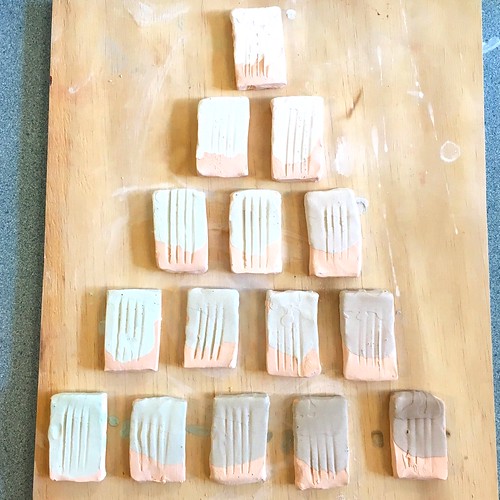
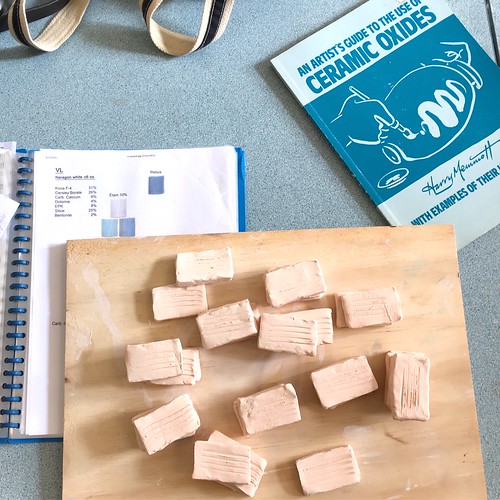
This time I bisque fired the spoons only to cone 04 - 1046ish as I read somewhere that they take the glaze better. Older bisque went to cone 05 or higher 1080C.

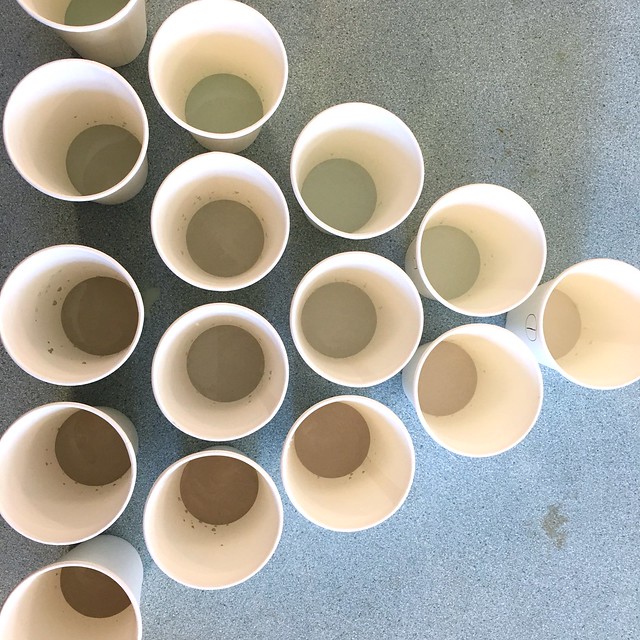
Remixed all old Cone 6 glazes lots and checked Specific Gravity.

Recorded the Spec Grav in Glaze book.

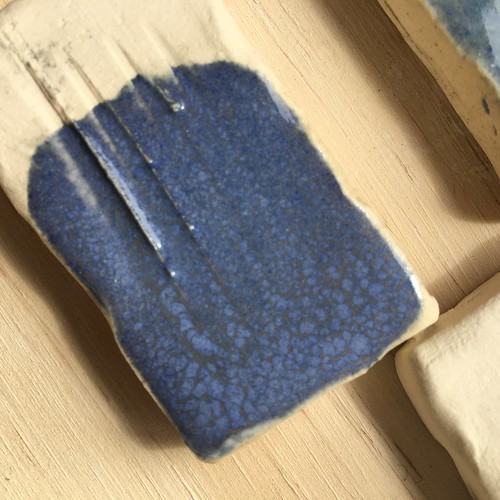
Arrowmont Blue Green ran badly and crazed a lot when it came out of the kiln. Pinged a lot. Good in bowl but crazed.

Fix this somehow? My version very glossy compared to online.

VC Matte yellow ran too. Good in bowl. Didn't craze.

Maybe they both need to be deflocculated?

Ashleys best was good. Very thick for spoons though prefer translucent.

I wrote out the recipe each time without Eckalite but I'm sure it must have gone in because the glaze worked?

Selsor Chun was great. Use again. See that some people add copper carb to bring up the blue. Test?

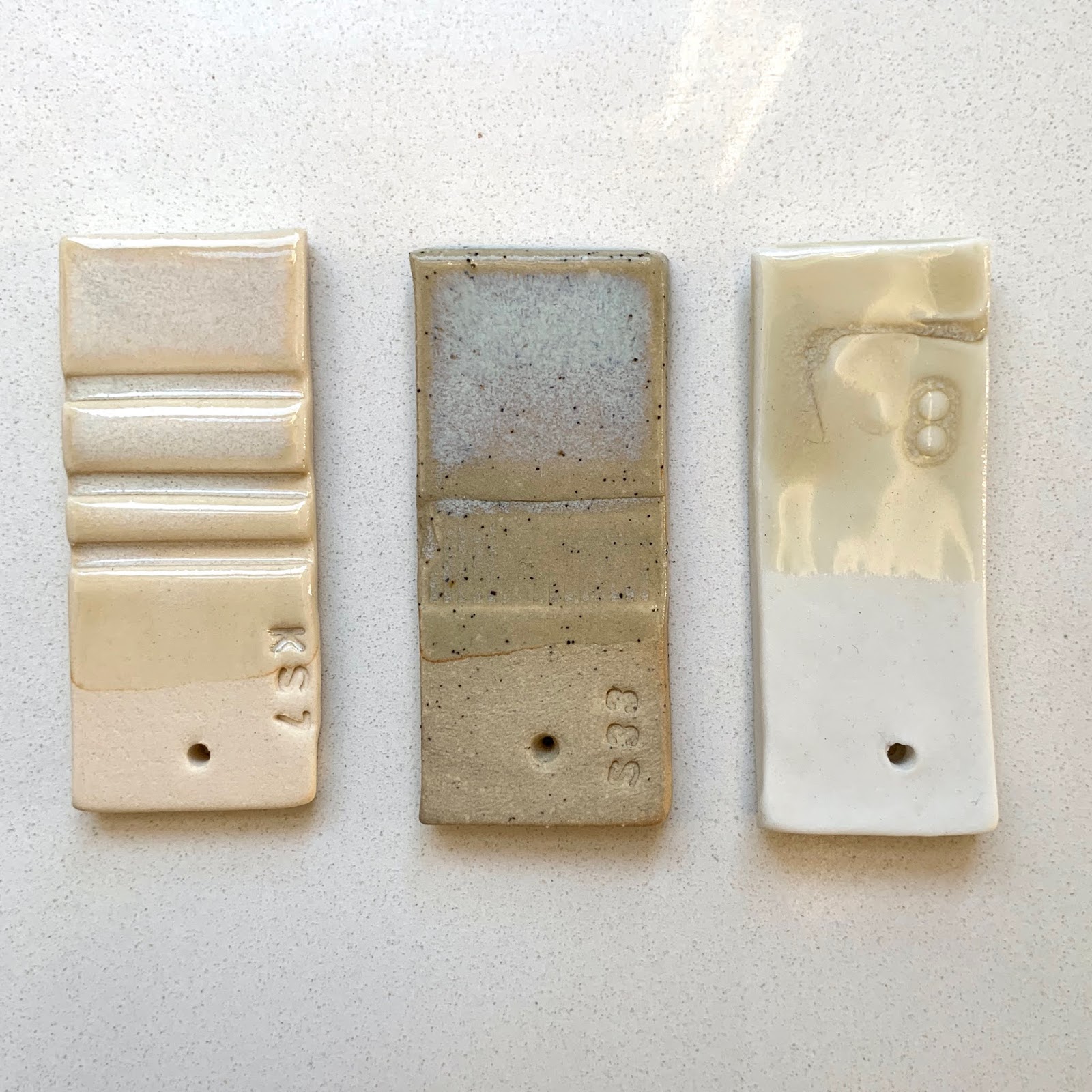
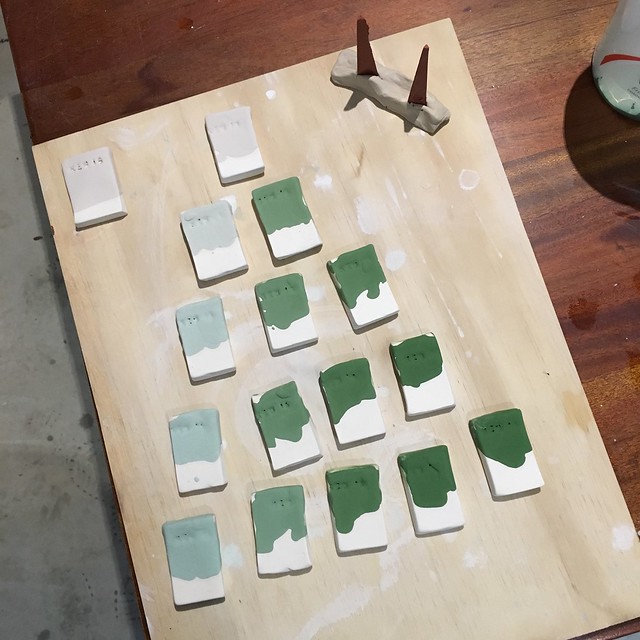
Val's Turquoise was well behaved. The lighter colour is better but could still be lighter. Its a bit flat.

conechartcelsiusSS

spoonsbowls Val's Turquoise bowls and spoons both %, clockwise from top left selsor chun, ashley's best, cesco clear.

spoonscu

selsor chun, clear cesco midfire paint on, val's turquoise 3% on spoon 1.5% on owl, bowl in VC Matte Yellow.
spoons most

Sunday, 4 August 2019

Cone 6 Glazes

Testing some cone 6 glazes from John Britt's Mid-Range Glazes and online resources

GREENS and BLUES

Alicia Clausen's Turquoise Matte 'The One'
 Nepheline Syenite 60
 Strontium Carbonate 25
 Silica 9
 EPK 4
 Lithium Carbonate 2
 
Copper Carbonate 3.5
 Bentonite 4
 Epsom Salts 1

Chun Seafoam
Soda Feldspar 41
Silica 27
Whiting 15
Eckalite 5
Zinc Oxide 12

Copper Carbonate 5
Titanium Dioxide 5
Bentonite 2

Pinnell Seafoam
Soda Feldspar 51.3
Strontium carbonate 25.5 
EPK 13.6
Frit 3134 9.6

Copper Carbonate 5
Titanium Dioxide 5

Pinnell's Strontium Matte 
Nepheline Syenite 57
Silica 8.6 
Ball Clay 9.5
Strontium Carbonate 19
Lithium Carbonate 5.9

Copper Carbonate 5
Titanium Dioxide 5
Bentonite 2

Arrowmont Blue Green 
Nepheline Syenite 44.6
Silica 13.3 Whiting 11.1
Eckalite 13.3
Gerstley Borate 11.1
Lithium Carbonate 6.6
Titanium Dioxide 6.2

Cobalt Carbonate 1
Bentonite 2

LIGHT BLUE

Selsor Chun
Soda Feldspar 34
Silica 30
Whiting 10
Dolomite 6
Frit 3134 17
Zinc Oxide 3
Tin Oxide 1

Red Iron Oxide 0.5-2
Bentonite 2
PURPLE
Ashley’s Best (purple)
Nepheline Syenite 27.2
Silica 25.3
Dolomite 16.2
Eckalite 13.3
Talc 11.4
Lithium Carbonate 6.6

Cobalt carbonate 2-4
Bentonite 2

CRAWL
Lalone Crawl
Neph Syenite 70 
Ball Clay 5
Magnesium Carbonate 25
YELLOW
V.C. Matte (Yellow) 
Nepheline Syenite 44.4
Silica 15.6 
 Whiting 8.9
Eckalite 11.1
Gerstley Borate 11.1
Lithium Carbonate 8.9

Rutile 4
Titanium Dioxide 6-10
Bentonite 2


Monday, 25 March 2019

HP Stoneware results

IMG_6906 (1)

glaze test colours
Glaze tests


14 Pine Street
Colour variations

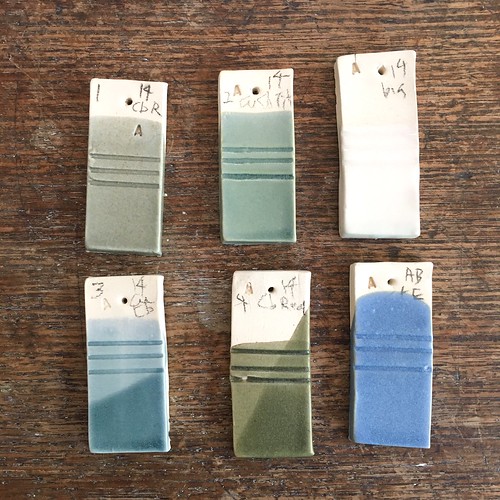
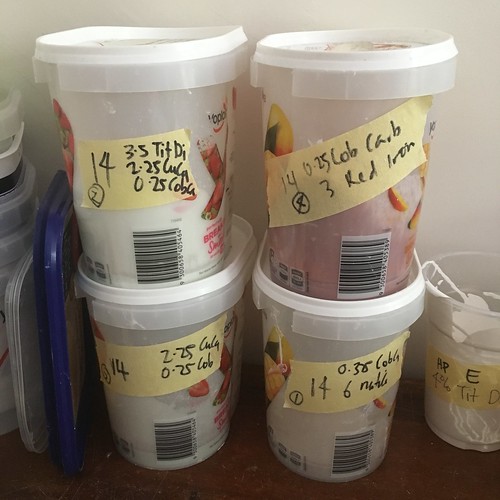
Mixed up 200gms Base Glaze and divided it into four batches.
Added these colourants
1 - 0.375% Cobalt Carbonate, 6% rutile
2 - 0.25% Cobalt Carbonate, 3.5% Titanium dioxide, 2.25% Copper Carbonate
3 - 0.25% Cobalt Carbonate, 2.25% Copper Carbonate
4 - 0.25% Cobalt Carbonate, 3% Red Iron Oxide

glaze14colours

Sunday, 8 April 2018

Cone 6 colour tests

Date: 9 April 2018
Clay: Keanes Stoneware 7

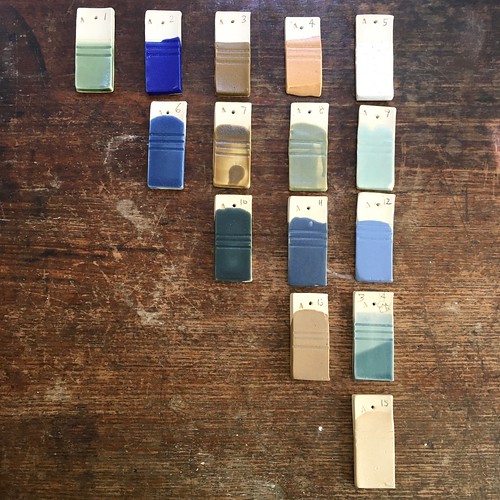
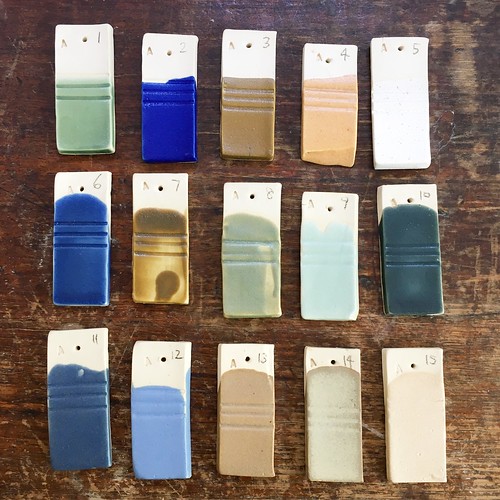
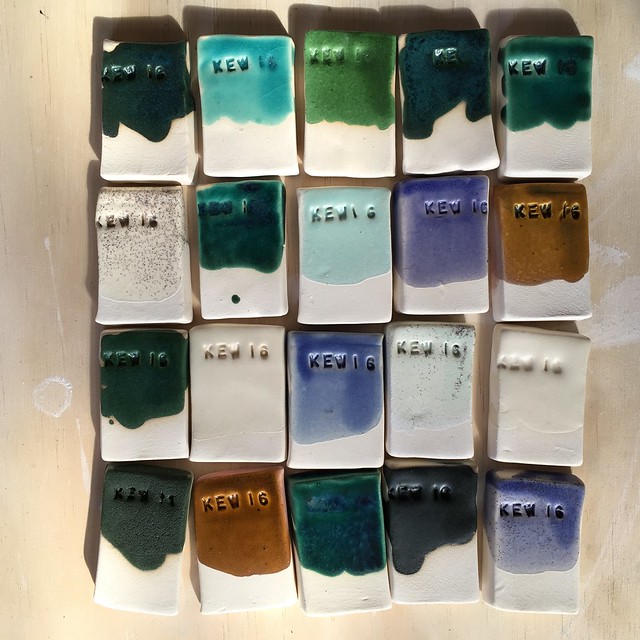
Following on from last week's Cone 6 tests. Adding different colour oxides in 50-50 mixture for HP and four different colour tests for 14Pine.

HP 
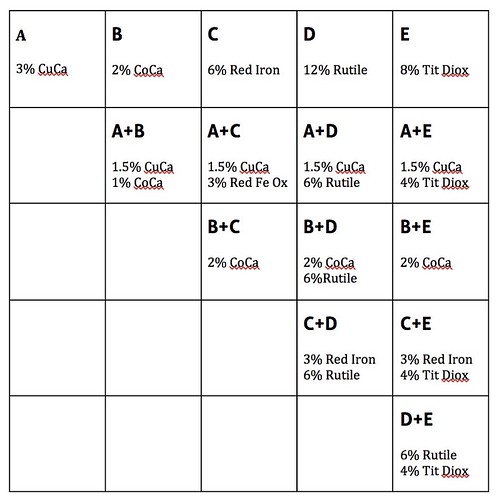
Colour tests 50:50 grid

Mixed up 250gms of Base Glaze and then divided it volumetrically into 5 equal batches.
Started the five test pots with double strength as they will be diluted by 50% when combined with another pot.

Added colourants as below:
A - 3% Copper Carbonate
B - 2% Cobalt Carbonate
C - 6% Red Iron Oxide
D - 12% Rutile flour
E - 8% Titanium Dioxide

glaze test colours

14 Pine Street
Colour variations

Mixed up 200gms Base Glaze and divided it into four batches.
Added these colourants
1 - 0.375% Cobalt Carbonate, 6% rutile
2 - 0.25% Cobalt Carbonate, 3.5% Titanium dioxide, 2.25% Copper Carbonate
3 - 0.25% Cobalt Carbonate, 2.25% Copper Carbonate
4 - 0.25% Cobalt Carbonate, 3% Red Iron Oxide


14P colour mixes
Kiln colour

Cone 6 tests

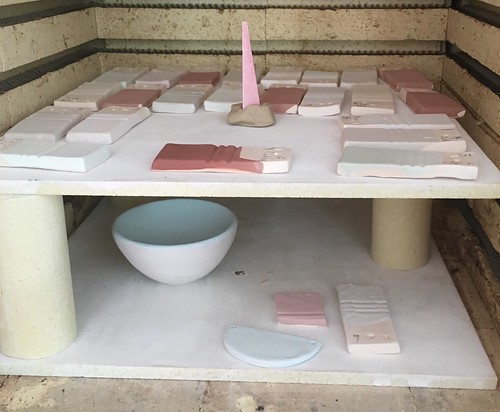
Three tests in recently fixed kiln.

Date: 7th March 2018
Clay: Keane's Stoneware 7

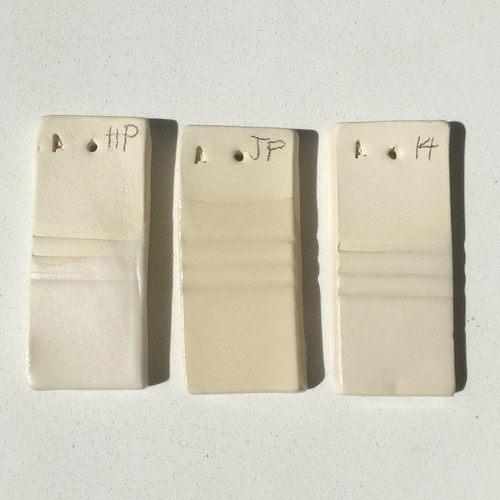
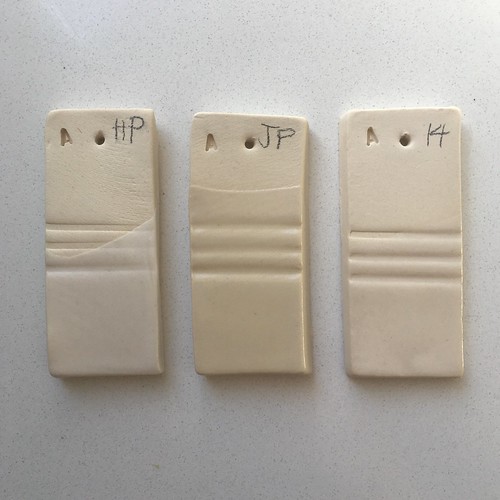
Hp glaze
HP shade


Hopeful Potter Matte

40      Potash Feldspar
20      Whiting
25      Eckalite (China Clay)
15      Silica

John Post Calcium Matte [JP. JPSM]

30.2    Ball Clay FX (Kentucky OM)
5.7      Frit 3134
32.5    Nepheline Syenite
16.3    Wollastonite
4.9      Whiting
10.4    Silica (Flint)

14 Pine
4.03     Frit 3124
28.20   Potash Feldspar
16.11   Whiting
19.17   Eckalite
32.50   Silica


Love them all.
Surprised JP wasn't more matte.
HP is lovely, read later its for ^8? Seems okay though, I"m going to perservere.
14 is taken from my Currie grid test at Pine Street. Initially I'd chosen another square but later it crazed so I went with another mix that hadn't.

Now to test with colour!


Monday, 19 February 2018

Earthenware tests 18/2

Out of the kiln this morning a number of Earthenware cone 04 glaze tests.
I'm still just trying to find successful base glazes, retesting some of the recipes I've tried before to make a base line for revisions.

All were fired to 1080 degrees Celcius on Keanes Earthenware tiles bisque fired to cone 04.

Worthington Clear 
EW cone 04

Gerstley borate     55%
Eckalite                30
Silica                    15

Results
Very clear glaze, some bubbles in suspension in thickest parts.

Glaze tests 18/2


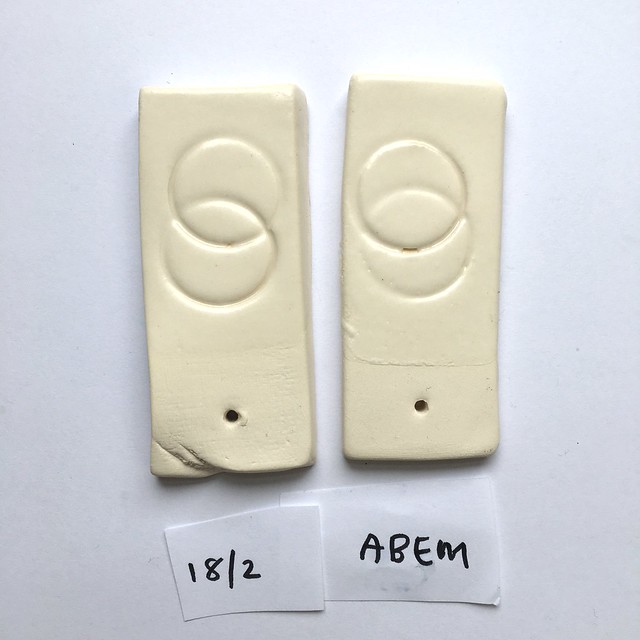
ABEM 
cone 04

Frit 3124               50
Eckalite                15.65
Whiting                16.65
Silica                    17.75
Total                            5

Results
Nice smooth matte glaze

Glaze tests 18/2


EB
clear EW, cone 04

Frit 4131              83.3
Eckalite               16.6
* batches 2 and 3 combined and whizzed up to be smoother

Results
This seems quite matte even though its a clear recipe. Much better results from first try when I must have put incorrect amounts in. Whizzed up. Need to buy a sieve.

Glaze tests 18/2


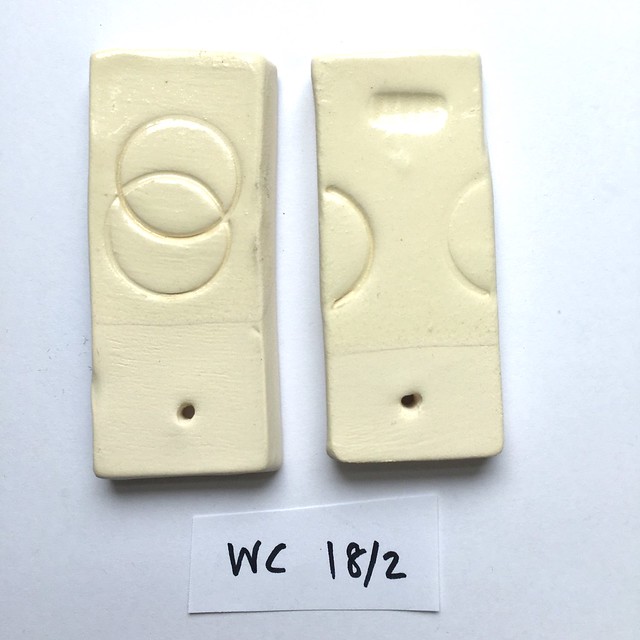
Julie's Satin
cone 04

Whiting                   17
Gerstley borate        27
Lithium carbonate     6
Nepheline syenite      4
Eckalite                    12
Silica                        34

Results
This glaze is still cracking. Which is a pity because I like the quality of its matte surface.
Will maybe try to modify it though I have tried before with no improvement.

Glaze tests 18/2/18


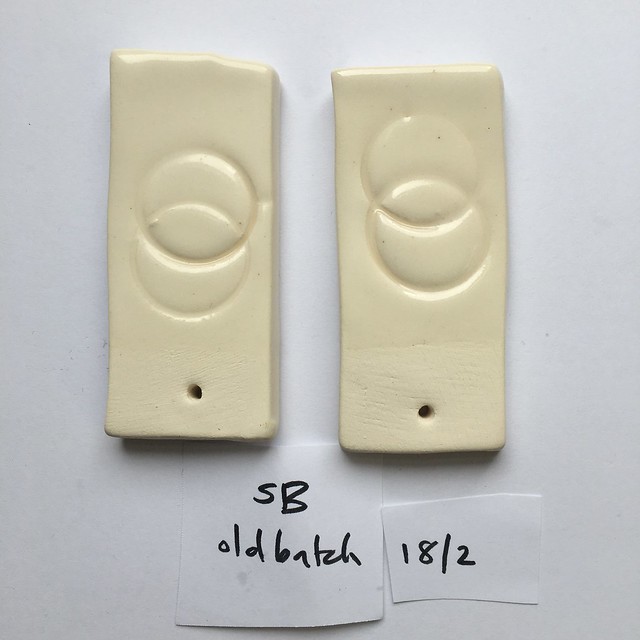
Satin Base SB

Results
This is the old batch remixed. The white version of this has a tendency to late crazing which is a pity because I really like the creamy surface of this.

Glaze tests 18/2/18

Earthenware tests 10/2/18

AB Clear glaze Frit Eckalite LB revised to use Strontium carbonate LB revised to use Whiting


  Glaze Glaze Glaze

Wednesday, 14 February 2018

Five Earthenware Base Recipes

Originally written 26 Sept 2016
glaze testing

Testing of five different Cone 04 matte or satin base recipes. All of the recipes have very similar ingredients, but different ratios.

These tests weren't ultimately successful as a week later four of them had crazed.

Retesting Julie's Satin (JMBC) and also testing a variation (JMBC revA), revised using hints from Glaze Simulator.
 A. Jackie's Matte via Priscilla Hollingsworth
38  Gerstley borate
10    Lithium carbonate
5    Nepheline syenite
5  Eckalite 2
42  Silica

5% Zircosil

Glaze testing

B. Satin Base (from here)

65.5 Ferro frit (4124) 3124
11    Nepheline syenite
5      Eckalite
42    Silica

C. Julie's Satin (from here)

27  Gerstley borate
7    Lithium carbonate
17  Whiting
4    Nepheline syenite
11  Eckalite 2
34  Silica

 D. Hirsh's Satin Matte

32  Gerstley borate
9    Lithium carbonate
17  Whiting
4    Nepheline Syenite
4    Eckalite 2
35  Silica

2% Bentonite

 E. Julie's Matte revised to fix crazing (JM rev A)

27  Gerstley borate
6    Lithium carbonate
17  Whiting
4    Nepheline syenite
12  Eckalite 2
34  Silica

Monday, 26 September 2016

Currie Grid

Glaze testing


Learning to do a stoneware test grid using Ian Currie's method for testing fluxes, alumina and silica ratios.

This is a Cone 6 Base Glaze.
Calculation page here.

Work out the flux ratios you want to use and then add them at the top. Click calculate and you have your formula. The Horizontal scale moves from C in the bottom left corner right towards high silica and upwards on the vertical plane towards high alumina.

Fluxes used are Frit 4124, Potash feldspar and Whiting.

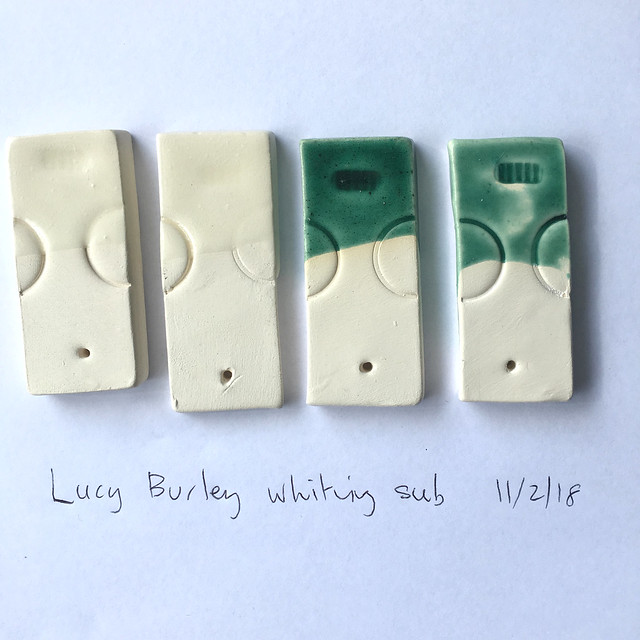
Lucy Burley's Matte

Glaze testing


I found this recipe on Ceramic Arts Daily's article about Green, Blue and Turquoise glazes. I love these colours and I'm looking for matte glazes for cone 04 firings.

 I have substituted Strontium carbonate for Barium carbonate.

I did a rough line blend, rough because I started the test using a teaspoon to measure units in the blend and ran out of glaze mix.

Lucy Burley's Matte Glaze Recipe

10    Strontium carbonate
45    Frit 3134
15    Potash Feldspar
15    Ball Clay FX
15    Eckalite 2

Results

I love the colours in these tests. You can't see in the photo but this glaze bubbled at the edges.

I think this is because I didn't add enough water to the glaze mix and it went on very thick.

It isn't very matte either, a little shiny for a matte glaze. I might try to tweak it if I make it again to tone down the shininess and fix the bubbling.


Saturday, 17 September 2016

Julie's Satin Triaxial - Blog Ceramique


Glaze testing

Julie


Julie


This glaze test is for another Blog Céramique triaxial - Julie's Satin Base in green/blue

It's based on a cone 04 satin/matte base glaze recipe, which I think is based on the 
popular Jackie's Base glaze found around the net - the ingredients are similar - but this has added Calcium Carbonate (as an opacifier?) and different ratios. I used it on Keane's Earthenware 37 fired in my home kiln, an old Ward.

I mixed this one at home and fired it with a mixed firing of bisque and glazed pieces. One of the benefits of firing to cone 04 is being able to mix loads.

I had problems with reaching temperature as I had the controller programmed wrong and the kiln turned off too early before the cone had bent. Took another hour of fiddling with the controller to get it melted.

I don't think I did slow cool on this firing but it sort of had a soak due to the mistake.

The only substitution is Eckalite 2 for EPK which is unavailable here.

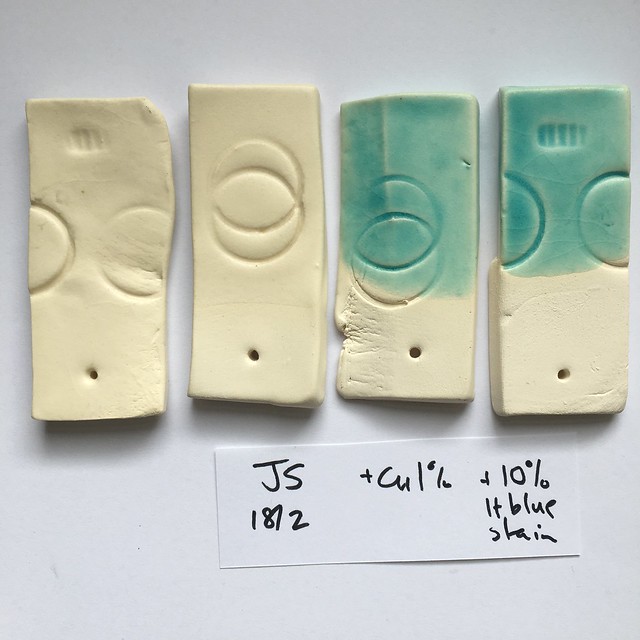
While I had the base mixed I did some extra experiments with cobalt, light blue stain and rutile.

Julie's Satin Base

17    Calcium carbonate
27    Gerstley borate
7      Lithium carbonate
4      Nepheline syenite
11    Eckalite 2 (my substitute for EPK)
34    Silica

In the Triaxial
A was the base glaze,
B was 3.5% Copper carbonate
C was 1% Chrome Oxide

Results

I think I might have made the colour too strong too, I can't remember if I divided the amounts into thirds or just put the whole amount in each corner.

As it is the chrome seems unmelted and has taken on a rough burnt looking texture where it is most concentrated. The colours certainly look different to the sample tests on the BC blog.

Also the glaze has crazed in its base form and on some of the copper side.

I love the finish of this one though and will try to reformulate it to fix the crazing. Has a lovely thick buttery matte texture.

Glaze testing

Naragon White cone 6 results

Glaze testGlaze tilesGlaze testing


Naragon White version 1

31%    Soda Feldspar


2      Bentonite


Mixed dry and then water added. Divided into three pots of 66.6ml each.


The triaxial with three corners as follows starting from the apex:


A 10%  Tin Oxide  (100 x 10 x 33.3/100) added 3.33g

B 7%    Copper Carbonate (100 x 7 x 33.3/100) added 2.33g
C 2%    Cobalt Carbonate, 10%  (100 x 10 x 33.3/100) added 0.66g
   10%   Rutile flour (100 x 10 x 33.3/100) added 3.33g

Fired to cone 6 in my Ward kiln. Slow cooled.

Results
Colour needs mixing with a blender, appears a bit grainy. Base glaze is pinkish from tin oxide. Poured rather than dipped. Need to repeat this test but concentrating on the lighter oxides, tiles 1, 2 and 3.
I like the way the rutile has added texture especially to the Cobalt corner.

My first glaze test

Glaze tilesGlaze making

My first attempt at mixing a glaze recipe from raw materials. I really love the images on the Blog Ceramique site and optimistically chose one of their Triaxial blends for my first glaze test. The base glaze recipe from Blog Ceramique is:

31     Kona F4
26     Gerstley Borate
6       Calcium carbonate
4       Dolomite
25     Silica
8       EPK

2      Bentonite

My translation substituted with Australian ingredients was this:

31     Soda Feldspar
26     Frit 3134
6      Calcium carbonate
4      Dolomite
25    Silica
8      Eckalite

2      Bentonite

Mixed dry and then water added. Divided into three pots of 66.6ml each.

The triaxial with three corners as follows starting from the apex:

A 10%  Tin Oxide  (100 x 10 x 33.3/100) added 3.33g
B 7%    Copper Carbonate (100 x 7 x 33.3/100) added 2.33g
C 2%    Cobalt Carbonate, 10%  (100 x 10 x 33.3/100) added 0.66g
   10%   Rutile flour (100 x 10 x 33.3/100) added 3.33g

pine street glaze course

Test tiles

I'd been interested in glaze making for a while when I enrolled in Pine Street's glaze making course in August 2016. The teacher was Greg Crowe.

In the first week we chose a glaze test to suit the type of firing we were doing. I've been wanting to experiment with stoneware clay fired to cone 6 after seeing so many great glazes and recipes online. Until now I've been focussed on earthenware, which I still like for its great colours, so I think I'll work to find recipes for cone 04 too.

I wasn't sure my kiln could fire to cone 6 temps but a test firing this week shows it easily makes that mark. Early on in this ceramics journey I bought a wheel and a kiln because I want to make and fire everything inhouse, it means I can work at my own pace and control each part of the process. My little old Ward kiln with its new controller is working well and I am slowly refining my firing schedules to get the perfect rise and fall. To mix up my own glazes is a logical progression.

 My reading list is up in a link list there on the left. I'll keep adding to it as I go and would love suggestions. If you know of any good glaze references or have your own glaze/ceramics blog leave the link in a comment below.

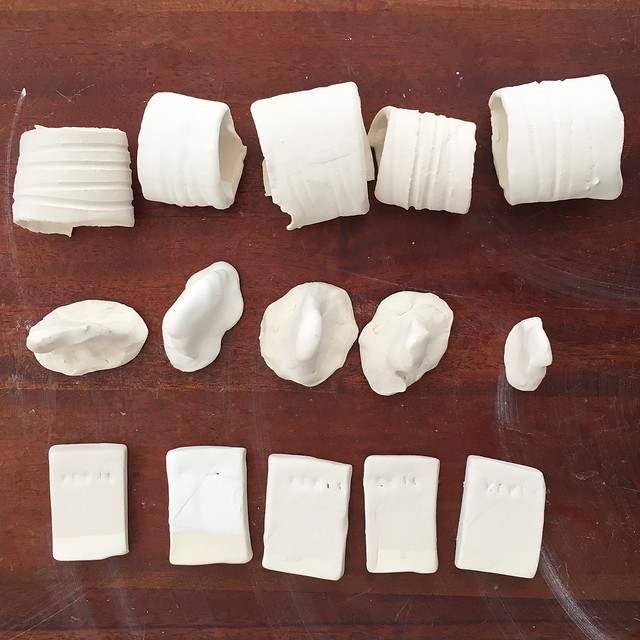
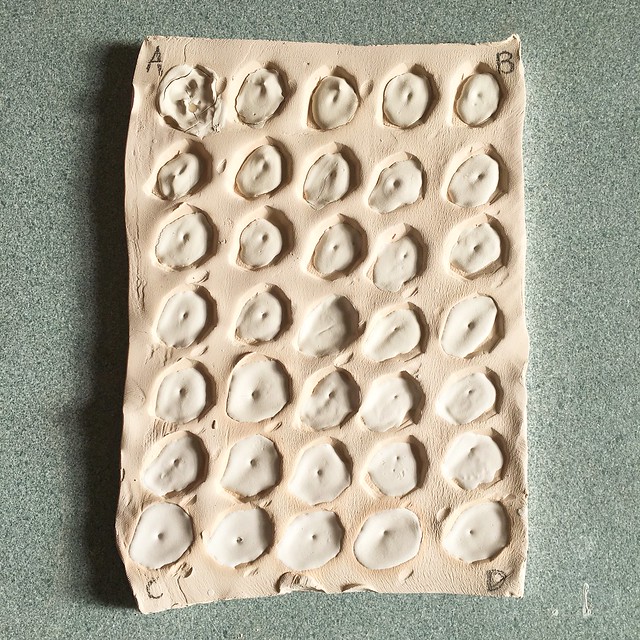
Week one at glaze school we made test tiles for future firings in a number of ways, both flat and pinched and napkin ring style and left them in the kiln room for firing to use for our first test next week.

Friday, 16 September 2016

glaze testing blog

glaze test tiles
This is a new blog to record my glaze testing. Please see my regular blog www.flowerpress.blogspot.com for everything else. I think one of the most important thing for glaze testing will be good record keeping so I hope to keep up with recipes, outcomes and photos here. I am focussing on Earthenware cone 04 recipes and Stoneware cone 6 firing recipes. The two clays I've been using at the moment are Keanes White Earthenware 37 and Keanes Stoneware 7.